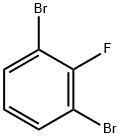
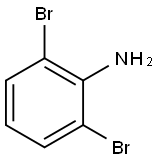
Step 1: To a mixture of 2,6-dibromoaniline (5.0 g, 20 mmol) and concentrated hydrochloric acid (12 N, 10 mL) was slowly added sodium nitrite (NaNO2, 2.1 g, 30 mmol) at 0 °C. The reaction mixture was stirred at 0-10°C for 1 h, followed by dropwise addition of an aqueous solution of ammonium tetrafluoroborate (NH4BF4, 4.2 g, 40 mmol). Stirring was continued at 0-10°C for 1 hour. After completion of the reaction, the precipitate was collected by filtration and dried. The dried residue was heated to 220°C and maintained for 2 hours for thermal decomposition. After cooling to room temperature, the product was dissolved with ethyl acetate (EA, 150 mL) and subsequently washed with sodium hydroxide solution (2N, 200 mL). The organic layer was dried over anhydrous sodium sulfate (Na2SO4), filtered and concentrated under reduced pressure to give 1,3-dibromo-2-fluorobenzene (1.45 g, 29% yield).