Uses
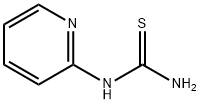
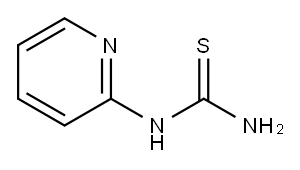
2-Pyridylthiourea is an intermediate used to prepare disubstituted thiazoles as potential antibacterial and antiinflammatory agents via condensation of phenacyl bromide with thioureas and thiosemicarbazones. It is also used in the synthesis of 2-amino-5-(thioaryl)thiazoles as potent and selective Itk inhibitors.
Synthesis
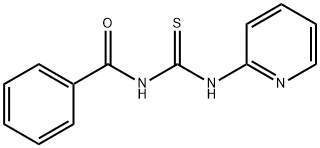
The general procedure for the synthesis of 1-(2-pyridyl)thiourea from 1-benzoyl-3-(2-pyridyl)-2-thiourea was as follows: N-(pyridin-2-ylthiocarbonyl)benzamide (2.3 g, 8.95 mmol) was suspended in a 10% aqueous NaOH solution (10.4 mL, 26 mmol) and stirred for 10 min at room temperature, then heated to reflux to continue the reaction for 10 minutes. Upon completion of the reaction, the mixture was cooled to 0 °C, diluted with 100 mL of water and subsequently extracted with ethyl acetate (3 × 150 mL). The organic phases were combined, dried with anhydrous magnesium sulfate, filtered and concentrated to give the crude product 1-(2-pyridyl)thiourea (1.2 g). Mass spectrometry (electrospray ionization) m/z (M+H) confirmed the product.
References
[1] Synthesis, 1988, # 6, p. 456 - 459
[2] Bioorganic and Medicinal Chemistry Letters, 2006, vol. 16, # 14, p. 3706 - 3712
[3] Bioorganic and Medicinal Chemistry Letters, 2008, vol. 18, # 2, p. 634 - 639
[4] Journal of the Chemical Society, 1955, p. 803
[5] Journal of Organic Chemistry USSR (English Translation), 1991, vol. 27, # 1.2, p. 177 - 182