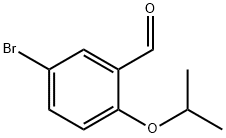
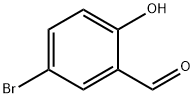
Step A: Synthesis of 5-bromo-2-isopropoxybenzaldehyde (AX). To a suspension of dimethylformamide (DMF) containing potassium carbonate (34.4 g, 249 mmol) and cesium carbonate (16.2 g, 50 mmol) were sequentially added 5-bromosalicylaldehyde (25.0 g, 124 mmol) and 2-iodopropane (25.0 mL, 249 mmol). The reaction mixture was stirred at room temperature overnight, followed by heating to 70 °C and continued stirring for 4 hours. Upon completion of the reaction, the volatile solvent was removed by rotary evaporation. The residue was dissolved and partitioned between methyl tertiary butyl ether (MTBE) and water. The aqueous layer was further extracted with MTBE and all organic phases were combined and washed sequentially with water, sodium hydroxide solution and saturated brine. The organic layer was dried over anhydrous magnesium sulfate and concentrated to dryness under reduced pressure to afford 5-bromo-2-isopropoxybenzaldehyde (AX, 30.0 g) as a light yellow oil in 99% yield.1H NMR (CDCl3, 400 MHz): δ 1.40 (d, J = 6.3 Hz, 6H), 4.65 (sept, J = 6.0 Hz, 1H), 6.89 (d, J = 9.0 Hz, 1H), 7.59 (dd, J = 9.0 and 2.7 Hz, 1H), 7.91 (d, J = 2.7 Hz, 1H), 10.39 (s, 1H).