Description
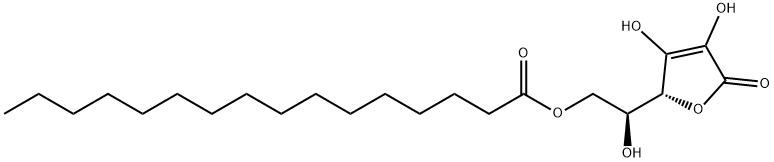
Ascorbyl palmitate is a lipophilic derivative of ascorbic acid (Item No.
14656) with antioxidant and antiproliferative activities.
1,2,3 It scavenges hydroxyl radicals in cell-free assays.
2 Ascorbyl palmitate (0.01%) reduces the rate of autoxidation of soybean, safflower, sunflower, peanut, and corn oil.
3 It inhibits increases in epidermal ornithine decarboxylase activity and DNA synthesis induced by phorbol 12-myristate 13-acetate (TPA; Item No.
10008014) in mice in a concentration-dependent manner when applied topically.
1 Ascorbyl palmitate (0.8 and 4 μmol per 200 μl of acetone, applied topically) reduces the number of tumors per mouse and the percentage of mice with tumors in a mouse skin two-stage model of tumor formation initiated and promoted by 7,12-dimethylbenz[a]anthracene (DMBA) and TPA, respectively. Formulations containing ascorbyl palmitate have been used as antioxidants and preservatives in foods, pharmaceuticals, and cosmetics.
Chemical Properties
Ascorbyl palmitate is a practically odorless, white to yellowish
powder.
Chemical Properties
Light yellow powder
Application
Ascorbyl Palmitate is an antioxidant formed by combining ascorbic acid with palmitic acid. ascorbic acid is not fat soluble but ascorbyl palmitate is, thus combining them produces a fat-soluble antioxidant. it exists as a white or yellowish white powder of citric- like odor. it is used as a preservative for natural oils, edible oils, colors, and other substances. it acts synergistically with alpha-tocopherol in oils/fats. it is used in peanut oil at a maximum level of 200 mg/kg individually or in combination.
Definition
A white or yellowish-white powder having a citrus-like odor. Mp 116–117C; soluble in alcohol and in animal and vegetable oils; slightly soluble in water.
Production Methods
Ascorbyl palmitate is prepared synthetically by the reaction of
ascorbic acid with sulfuric acid followed by reesterification with
palmitic acid.
General Description
Pharmaceutical secondary standards for application in quality control, provide pharma laboratories and manufacturers with a convenient and cost-effective alternative to the preparation of in-house working standards.
Ascorbyl Palmitate is a lipophilic ascorbic acid derivative, used as an antioxidant in both food and cosmetics industries.
Pharmaceutical Applications
Ascorbyl palmitate is primarily used either alone or in combination
with alpha tocopherol as a stabilizer for oils in oral pharmaceutical
formulations and food products; generally 0.05% w/v is used. It
may also be used in oral and topical preparations as an antioxidant
for drugs unstable to oxygen. The combination of ascorbyl
palmitate with alpha tocopherol shows marked synergism, which
increases the effect of the components and allows the amount used
to be reduced.
The solubility of ascorbyl palmitate in alcohol permits it to be
used in nonaqueous and aqueous systems and emulsions.
Biochem/physiol Actions
6-O-Palmitoyl-L-ascorbic acid possesses metastasis inhibitory and anti-tumor activity. Ascorbyl palmitate exhibits antioxidant activity by protecting the cell membranes from oxidative damage.
Safety
Ascorbyl palmitate is used in oral pharmaceutical formulations and
food products, and is generally regarded as an essentially nontoxic
and nonirritant material. The WHO has set an estimated acceptable
daily intake for ascorbyl palmitate at up to 1.25 mg/kg bodyweight.
LD50 (mouse, oral): 25 g/kg
LD50 (rat, oral): 10 g/kg
storage
Ascorbyl palmitate is stable in the dry state, but is gradually
oxidized and becomes discolored when exposed to light and high
humidity. In an unopened container, stored in a cool place, it has a
shelf life of at least 12 months. During processing, temperatures
greater than 658℃ should be avoided.
The bulk material should be stored in an airtight container at
8–158℃, protected from light.
Incompatibilities
Incompatibilities are known with oxidizing agents; e.g. in solution
oxidation is catalyzed by trace metal ions such as Cu2+ and Fe3+.
Regulatory Status
GRAS listed. Accepted for use as a food additive in Europe.
Included in the FDA Inactive Ingredients Database (oral, rectal,
topical preparations). Included in nonparenteral medicines licensed
in the UK.
References
[1] Patent: CN105315244, 2016, A. Location in patent: Paragraph 0047-0050