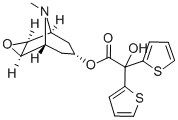
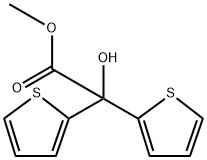
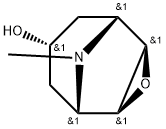
Example 1: 7 mol% NHC (relative to compound (1)) in THF at room temperature. In an anhydrous flask containing about 7.85 g of activated 4A molecular sieves, methyl 2,2-dithienylglycolate (2) (R = Me, 3.97 g, 15.6 mmol) and rel-(1R,2R,4S,5S,7s)-9-methyl-3-oxa-9-azatricyclo[3.3.1.02,4]nonan-7-ol (1) (2.61 g. 16.8 mmol) was dissolved in THF (14 mL). Another flask was taken and 1-butyl-3-methylimidazolium tetrafluoroborate (210 μL, 1.12 mmol), KOtBu/THF solution (960 μL, 0.96 mmol), and THF (1.0 mL) were added, and stirred for 15 min at room temperature. Subsequently, this mixture was transferred to a flask containing rel-(1R,2R,4S,5S,7s)-9-methyl-3-oxa-9-azatricyclo[3.3.1.02,4]nonan-7-ol solution using a syringe. The syringe and flask were washed with THF (2 x 0.5 mL) and the reaction mixture was stirred at room temperature for 18 h. HPLC analysis showed 86% yield of the expected product.After 18 h, the mixture was filtered and the molecular sieves were washed with THF (2 x 20 mL). The filtrate was concentrated to dryness and the residue was dissolved in toluene (30 mL) and 1M HCl (30 mL). Solid precipitation was observed during phase separation; the suspension was filtered and the solids were washed with toluene (30 mL) and redissolved in the separated aqueous phase. The aqueous phase suspension was cooled to 0 °C and alkalized to the proper pH by adding solid K2CO3. The mixture was stirred at 0 °C for about 30 min, and the resulting solid was filtered, washed with cold water, and dried first on a filter, followed by vacuum drying at 45 °C for 18 h to give the white solid product (3) (4.30 g, 73%, HPLC purity = 99.89%).