Chemical Properties
solid
Uses
Fungicide, often added to pesticide mixtures used to control diseases among fruits, vegetables.
Definition
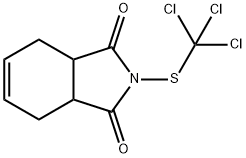
ChEBI: A dicarboximide that is 3a,4,7,7a-tetrahydrophthalimide in which the hydrogen attached to the nitrogen is replaced by a trichloromethyl group. A non-systemic fungicide introduced in the 1950s, it is widely used for the control of fungal diseases in fruits,
vegetables, and ornamental crops.
Uses
Fungicide; bacteriostat in soap.
General Description
CAPTAN(133-06-2) is a white solid dissolved in a liquid carrier. CAPTAN(133-06-2) is a water emulsifiable liquid. CAPTAN(133-06-2) can cause illness by inhalation, skin absorption and/or ingestion. The primary hazard of this material is that CAPTAN(133-06-2) poses a threat to the environment. In case of release immediate steps should be taken to limit its spread to the environment. Since CAPTAN(133-06-2) is a liquid CAPTAN(133-06-2) can easily penetrate the soil to contaminate groundwater. CAPTAN(133-06-2) is used as a fungicide.
Reactivity Profile
CAPTAN decomposes at or near the melting point. This chemical is incompatible with strong alkaline and oxidizing materials, sulfur and (sulfur + moisture).
Air & Water Reactions
Slowly hydrolyzed in aqueous neutral and acidic media. Rapidly hydrolyzed in alkaline media. Insoluble in water.
Hazard
A questionable carcinogen. A skin irritant.
Avoid inhalation of dust or spray mist. Avoid con-
tamination of feed and foodstuffs.
Health Hazard
Vapor irritates eyes. Ingestion causes depression, lachrymation, labored respiration, diarrhea.
Potential Exposure
Captan is a thiophthalimide compound
used as an agricultural fungicide for field crops and storage
of produce and also as a preservative in cosmetics; an overthe-counter-drug.
Fire Hazard
Special Hazards of Combustion Products: Irritating and toxic gases are produced in a fire; they may include sulfur dioxide, hydrogen chloride, phosgene, and oxides of nitrogen.
First aid
If this chemical gets into the eyes, remove any
contact lenses at once and irrigate immediately for at least
15 minutes, occasionally lifting upper and lower lids. Seek
medical attention immediately. If this chemical contacts the
skin, remove contaminated clothing and wash immediately
with soap and water. Seek medical attention immediately.
If this chemical has been inhaled, remove from exposure,
begin rescue breathing (using universal precautions, including resuscitation mask) if breathing has stopped and CPR if
heart action has stopped. Transfer promptly to a medical
facility. When this chemical has been swallowed, get medical attention. Give large quantities of water and induce
vomiting. Do not make an unconscious person vomit.
Shipping
UN2773 Phthalimide derivative pesticides, solid,
toxic, Hazard Class: 6.1; Labels: 6.1-Poisonous materials,
Technical Name Required. UN2811 Toxic solids, organic,
n.o.s., Hazard Class: 6.1; Labels: 6.1-Poisonous materials,
Technical Name Required.
Incompatibilities
Incompatible with tetraethyl pyrophosphate, parathion. Keep away from strong alkaline materials(e.g., hydrated lime) as captan may become unstable. May
react with water releasing hydrogen chloride gas. Corrosive
to metals in the presence of moisture.
Description
Captane is a pesticide belonging to the thiophtalimide
group, mainly affecting agricultural workers. As a
sensitizer and photosensitizer, it can induce contact
urticaria. Its is used as a fungicide and a bacteriostatic
agent in cosmetics and toiletries, particularily in
shampoos. Cases of contact dermatitis were reoprted
in painters, polishers and varnishers.
Waste Disposal
Captan decomposes fairly
readily in alkaline media (pH >8). It is hydrolytically
stable at neutral or acid pH but decomposes when heated
alone at its freezing/melting point. Alkaline hydrolysis is
recommended
Flammability and Explosibility
Notclassified
Agricultural Uses
Fungicide: Most uses of captan on food crops in the United States have been canceled since 1989. It is still used in apple production, almonds and strawberries. It is often applied to packing and shipping boxes for fruits and vegetables. Captan is rapidly degraded in natural soil by chemical as well as biologic means (estimated half-life, days to weeks). It is also used as a preservative for awnings, draperies and leather, as a root dip and seed treatment. It is also added to paints, wallpaper paste, plastic and leather goods. There are over 320 federally registered pesticide products that contain captan.
Trade name
AACAPTAN®; AGROSOL S®[C]; AGROX® 2-WAY and 3-WAY[C]; AMERCIDE®; APRON®[C]; BEISTERGARD®; BANGTON®; BEAN SEED PROTECTANT®; CAPTANCAPTENEET® 26,538; CAPTAF®; CAPTAF®; CAPTAN® 50 W; CAPTAN SC®; CAPTEX®; CRIPTAN®; ESSO® FUNGICIDE 406; FLIT® 406; FUNGUS BAN® TYPE II; FUNGICIDE 406®; GLYODEX® 37-22; GRANOX PFM®; GUSTAFSON CAPTAN 30-DD; HEXACAP®; ISOTOX SEED TREATER® “D” and “F”; KAPTAN®; MALIPUR®; MERPAN®; MICRO-CHECK® 12; MIOSTAT®; NERACID®; ORTHOCIDE®; OSOCIDE®; POTATO SEED PIECE PROTECTANT®; SR 406®; STAUFFER CAPTAN®; TRIMEGOL®; VANICIDE®; VANICIDE® P-75; VANICIDE® 89; VANICIDE® 89RE; VANGARD® K; VANGUARD® K; VONDCAPTAN®
Mechanism of action
Captan's mode of action involves a multi-site inhibition of fungal metabolic processes. It disrupts several essential pathways within the fungal cell, including those involved in respiration and energy production which ultimately leads to fungal cell death. It inhibits key enzymes in pathways like glycolysis and the Krebs cycle, which are crucial for ATP (adenosine triphosphate) production, which is the primary energy currency in plants, essential for photosynthesis and respiration. It also interferes with the synthesis of the fungal cell wall, further weakening the cell and leading to its breakdown.
Synthesis
1,2,3,4-tetrahydrophthalic anhydride was formed by the reaction of butadiene with maleic anhydride, then 1,2,3,4-tetrahydrophthalimide was synthesized by the action of ammonia, and finally gramicidin was obtained by the reaction of trichlorothiomethane to
Environmental Fate
Biological. In water, captan reacted with the fungicide L-cysteine forming a compound
with an absorption maximum of 272 μm which was identified as 2-thiazolidinethione-4-
carboxylic acid. In addition, tetrahydrophthalimide also formed (Lukens and Sisler, 1958).
Soil. The half-lives of captan in soil ranged from 3.5 days (pH 6.4, moisture content
17.5%) to >50 days (pH 6.2, moisture content 1.6%) (Burchfield, 1959). The half-lives of
captan in a sandy loam, clay loam and an organic amended soil under non-sterile conditions
were 10–354, 3.4–587 and 7.0–213 days, respectively, while under sterile conditions the
half-lives were 9.4–373, 2.8–303 and 4.3–191 days, respectively (Schoen and Winterlin,
1987).
Chemical/Physical. Captan undergoes hydrolysis under neutral or alkaline conditions
yielding 4-cyclohexene-1,2-dicarboximide, carbon dioxide, hydrogen chloride and sulfur
(Wolfe et al., 1976a). The estimated hydrolysis half-life of captan in a phosphate buffer
solution at pH 7.07 and 28–29°C is 2.96 hours. Between the pH range 2 to 6, the estimated
hydrolysis half-life is 10.70 hours (Wolfe et al., 1976a). Worthing and Hance (1991)reported hydrolysis half-lives of 8.3–32.4 hours and <2 minutes at pH values 7 and 10,
respectively.
Decomposes at or near the melting point (Hartley and Kidd, 1987).
Metabolic pathway
Captan contains an unstable trichloromethylthio (sulfenyl) moiety that
has been shown to undergo rapid hydrolytic and metabolic degradation
to tetrahydrophthalimide (2).
Studies of the decomposition of [35S]captanw ith conidia of Neurospora
crassa (Richmond and Somers, 1968) showed that the trichloromethythio
moiety can be transferred to the sulfur atoms of thiols such as cysteine
and glutathione (Richmond and Somers, 1966). Thus, in the presence of
thiols such as glutathione, captan is cleaved at the N-S bond to form
thiophosgene (3) and other gaseous products such as hydrogen sulfide,
hydrogen chloride and carbonyl sulfide (see Scheme 2). Thiophosgene is
rapidly hydrolysed by water. The trichlormethythio group and thiophosgene
are believed to be intermediates in the formation of thiazolidine-2-
thione-4-carboxylic acid (4) which is an addition product with cysteine. A
thiazolidine derivative of glutathione is also formed (5). Biotransformation
of captan in mammals generates primarily thiophosgene (3) and
tetrahydrophthalimide (2). Tetrahydrophthalimide (2) and various of its
hydroxylated derivatives are excreted in the urine. The thiophosgeneglutathione
adduct (5) subsequently degrades and is eventually excreted
in the urine as 2-thiazolidinethione-4-carboxylic acid (4).
storage
Color Code—Blue: Health Hazard/Poison: Storein a secure poison location. Prior to working with captanyou should be trained on its proper handling and storage.Store in tightly closed containers in a cool, well-ventilatedarea away from water, heat, and incompatible materials.Metal containers involving the transfer of this chemicalshould be grounded and bonded. Where possible, automatically pump liquid from drums or other storage containers toprocess containers. Drums must be equipped with selfclosing valves, pressure vacuum bungs, and flame arresters.Use only nonsparking tools and equipment, especially whenopening and closing containers of this chemical. Sources ofignition, such as smoking and open flames, are prohibitedwhere this chemical is used, handled, or stored in a mannerthat could create a potential fire or explosion hazard. A regulated, marked area should be established where this chemical is handled, used, or stored in compliance with OSHAStandard 1910.1045.
Toxicity evaluation
The half-life of captan is 1–10 days in a soil environment, and
hours to days in water depending on acidities and temperatures.
Captan is not mobile in soil but can significantly
evaporate from the soil surface. It is quickly degraded in neutral
water.