Chemical Properties
Pale-Yellow Powder
Uses
A dihydropyridine calcium channel blocker. Antihypertensive.
Uses
long-acting dihydropyridine calcium channel blocker, antihypertensive
Definition
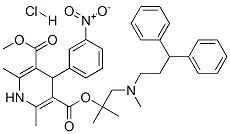
ChEBI:Lercanidipine hydrochloride is a diarylmethane.
Brand name
Cardiovasc (Recor dati, Italy); Carmen (Recordati, Italy); Corifeo (Recordati,
Italy); Lercadip (Recordati, Italy); Lercan (Recordati,
Italy); Lercapin (Recordati, Italy); Lercaton (Recordati,
Italy); Lerkamen (Recordati, Italy); Lerzam (Recordati,
Italy); Renovia (Recordati, Italy); Vasodip (Recordati,
Italy); Zandip (Recordati, Italy); Zanicor (Recordati, Italy).
Biological Activity
L-type Ca 2+ channel blocker that displays higher vascular selectivity than Felodipine (4-(2,3-Dichlorophenyl)-1,4-dihydro-2,6-dimethyl-3,5-pyridinedicarboxylic acid ethyl methyl ester ). Causes peripheral vasodilation with only weak negative inotropic activity. Antihypertensive.
Biochem/physiol Actions
Lercanidipine hydrochloride is a L-type (Cav1.2b) vascular channel antagonist; L-type (Cav1.2a) cardiac channel agonist voltage-dependent and highly lipophylic compound, which exhibits a slower onset and longer duration of action than other calcium channel antagonists; an antihypertensive agent in patients with mild-to-moderate hypertension; more vasoselective than lacidipine and amlodipine.
Synthesis
The general procedure for the synthesis of 3-(1-((3,3-diphenylpropyl)(methyl)amino)-2-methylpropan-2-yl)5-methyl 2,6-dimethyl-4-(3-nitrophenyl)-1,4-dihydropyridine-3,5-dicarboxylate hydrochloride from the compound (CAS:957215-03-1) is as follows: 10 mmol of oxalate salt (Example 4) was dissolved in 100 mL of dichloromethane and 20 mL of aqueous solution containing 20 mmol of potassium carbonate was added. The organic phase was separated and the aqueous phase was extracted with 2 x 10 mL of dichloromethane. The organic phase was combined and treated with 20 mL of 1N hydrochloric acid solution. The organic phase was separated and concentrated. The residue was dissolved in 2,000 mL of water and 2 mL of 1N hydrochloric acid and 5 mL of saturated aqueous sodium chloride were added to form I hydrochloride hemihydrate and the product was collected by filtration. Yield: 6.2 g (95%); Purity: 99.8% (HPLC); Melting point: 118-122 ° C. HPLC conditions: RP 16 column, 125×3 mm ID, 5 μm, Detection wavelength: 233 nm; Eluent composition: 0.01 mol Na2HPO4/MeOH/acetonitrile=25/65/10; Retention time: about 15 min.
Drug interactions
Potentially hazardous interactions with other drugs
Aminophylline and theophylline: possibly increased
aminophylline and theophylline concentration.
Anaesthetics: enhanced hypotensive effect.
Antibacterials: metabolism possibly inhibited by
clarithromycin, erythromycin and telithromycin -
avoid with erythromycin.
Antidepressants: enhanced hypotensive effect with
MAOIs.
Antiepileptics: effect reduced by carbamazepine,
barbiturates, phenytoin and primidone.
Antifungals: metabolism possibly inhibited by
itraconazole and ketoconazole - avoid; negative
inotropic effect possibly increased with itraconazole.
Antihypertensives: enhanced hypotensive effect,
increased risk of first dose hypotensive effect of post�synaptic alpha-blockers.
Antivirals: concentration increased by ritonavir -
avoid.
Cardiac glycosides: digoxin concentration increased.
Ciclosporin: concentration of both drugs may be
increased - avoid.
Grapefruit juice: concentration increased - avoid
References
[1] Patent: EP1860102, 2007, A1. Location in patent: Page/Page column 1; 8; 15


![3,5-Pyridinedicarboxylic acid, 1,4-dihydro-2,6-dimethyl-4-(3-nitrophenyl)-, 3-[2-[(3,3-diphenylpropyl)methylamino]-1,1-dimethylethyl] 5-methyl ester, ethanedioate (1:1)](/CAS/20211123/GIF/957215-03-1.gif)
