Description
Sintofen is a plant growth regulator. It is moderately soluble in water, is non-volatile and a low potential of leaching to groundwater. It is persistent in both soil and aquatic systems. It has a moderate mammalian toxicity and a high potential for bioaccumulation. Its toxicity to aquatic organisms is low to moderate and it is moderately toxic to birds, earthworms and honeybees.
Chemical Properties
The original drug is a yellow-white powder with a slight odor. Its mp is 260-263℃, and its relative density is 0.06. It is slightly soluble in water and most organic solvents, and soluble in sodium hydroxide solution.
Uses
Cintofen is used as benzopyridazine plant growth regulators. Primarily used as an emasculator, they inhibit pollen development in cereal crops, rendering them infertile and preventing self-pollination, thus allowing cross-pollination and the production of hybrid seeds. In wheat and other small grains, before pollen formation, the tapetum cells, which provide nutrients for microspore development, are inhibited by the agent, thus suppressing the development of uninucleate microspores.
Definition
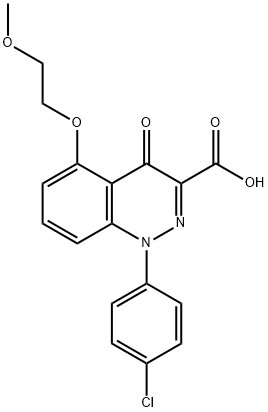
ChEBI: A member of the class of cinnolines that is 1-(p-chlorophenyl)cinnolin-4-one which is substituted at positions 3 and 5 by carboxy and 2-methoxyethoxy groups, respectively. It is a chemical hybridisation agent, used for the sterilisation of whe
t.
Production Methods
Sintofen is commercially produced through an efficient one-pot process starting with 3-(2,6-dichlorophenyl)-2,3-dioxopropanoate ethyl 2-(4-chlorophenyl)hydrazone, which undergoes base-catalysed cyclization in an organic solvent like dimethylformamide with potassium carbonate to form the 5-chloro intermediate, followed by in situ addition of potassium hydroxide in ethylene glycol monomethyl ether for nucleophilic substitution to introduce the 2-methoxyethoxy group, yielding the active substance.
Mechanism of action
Sintofen works by preventing the formation of viable pollen in wheat. It is absorbed through the leaves and translocated to the site of gametogenesis, where it inhibits the formation of pollen. This action leads male plant sterility.
Pesticide Type
Plant Growth Regulator