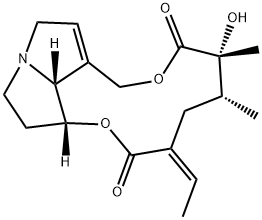
Description
This hepatotoxic alkaloid is widely distributed among the Senecio species, being found in S. aureus, S. ilicifolius Thunb., S. integerrirnus, S. pseudaarnica, S. squaUdus, S. viscosus and S. vulgaris. The base is laevorotatory with [α]D - 54.6° (CHCI3 ) and the crystals sublime at 130-140°CfO.2 mm. The nitrate has m.p. 214°C;[α]D - 34.2° (H2 0); the aurichloride, m.p. 186°C; the picrate, m.p. 191°C and the methiodide, m.p. 249°C. Alkaline hydrolysis furnishes retronecine and senecic acid (6-hydroxy-5-methyl-2-heptene-3 :6-dicarboxylic acid).
Chemical Properties
White crystalline powder, soluble in organic solvents such as methanol, ethanol, DMSO, etc., derived from Senecio scandens Buch.-Ham. ex D. Don, Senecio vulgaris L. whole herb, Senecio chrysanthemoides DC. Senecio jacobaea L. root.
Uses
Senecionine is a pyrrolizidine alkaloid with the potential to affect hepatic drug metabolizing enzymes in rat cells.
Definition
ChEBI: A pyrrolizidine alkaloid isolated from the plant species of the genus Senecio.
Safety Profile
Poison by intravenous,intraperitoneal, and possibly other routes. Anexperimental teratogen. Other experimental reproductiveeffects. Mutation data reported. When heated todecomposition it emits toxic fumes of NOx.
References
Grandval, Lajoux., Cornpt. rend., 120,1120 (1895)
Grandval, Lajoux., Bull. Soc. Chirn. Fr., 13,942 (1895)
Manske., Can. J. Res., S, 651 (1931)
Manske., ibid, 14B, 6 (1936)
Barger, Blackie., J. Chern. Soc., 584 (1937)
Blackie., Pharrn. J., 138,102 (1937)
Manske., Can. J. Res., 17B, I (1939)