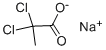
Description
Dalapon sodium is a selective herbicide. It is highly soluble in water and volatile. Based on its chemical properties it has a tendency to leach to groundwater. Data suggests it is moderately persistent in soil systems and can be persistent in some water systems. It is relatively non-toxic to mammals and has a low potential for bioaccumulation. Dalapon sodium is a recognised irritant. It has a moderate toxicity to most aquatic organisms and honeybees but is less harmful to birds and earthworms.
Uses
2,2-Dichloropropionic acid sodium salt is a selective, systemic herbicide used to control perennial and annual grasses on noncrop land, fruits, vegetables and some aquatic weeds.
Production Methods
Dalapon-sodium, the sodium salt of 2,2-dichloropropionic acid, is commercially produced through a neutralisation reaction involving its parent acid and a sodium base. The process begins with the synthesis of 2,2-dichloropropionic acid, typically via chlorination of propionic acid or its derivatives under controlled conditions. This acid is then reacted with sodium hydroxide in aqueous solution to form dalapon sodium, a water-soluble compound.
Mechanism of action
Selective, systemic absorbed through leaves and roots. Inhibition of lipid synthesis.
Environmental Fate
Soil. Undergoes dechlorination and the liberation of carbon dioxide in soil. The residual
activity is limited to approximately 3–4 months (Hartley and Kidd, 1987). The average
half-life for dalapon-sodium in soil incubated in the laboratory under aerobic conditions
was 15 days (Namdeo, 1972)
Photolytic. Dalapon (free acid) is subject to photodegradation. When an aqueous
solution (0.25 M) was irradiated with UV light at 253.7 nm at 49°C, 70% degraded in 7
hours. Pyruvic acid is formed which is subsequently decarboxylated to acetaldehy
Chemical/Physical. Slowly reacts with moisture at room temperature forming pyruvic
acid (Frank and Demint, 1969; Kenaga, 1974), hydrochloric acid and sodium chloride
(Kenaga, 1974; Wolfe et al., 1990). The reported hydrolysis half-life of dalapon
Products reported from the combustion of the free acid (dalapon) at 900°C include
carbon monoxide, carbon dioxide, chlorine and hydrochloric acid (Kennedy et al., 1972a)