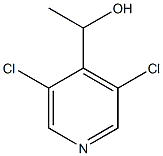
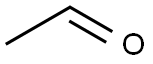
Tetrahydrofuran (THF, 3L) and diisopropylamine (DIPA, 315mL, 2.24mol) were added to a three-necked 12L round-bottomed flask and the mixture was cooled to -78°C. Slowly n-butyllithium (1.6 M in hexane, 1400 mL, 2.24 mol) was added. After the addition, a THF solution of 3,5-dichloropyridine (296.7 g, 2.00 mol) was slowly added at -78 °C. The reaction mixture immediately changed to a yellow solution, followed by the formation of a rust-colored suspension. After the addition was complete and the temperature stabilized at -78 °C, a THF (600 mL) solution of acetaldehyde (230 mL, 4.05 mol) was slowly added. The reaction continued to be stirred at -78 °C for 3 hours. Subsequently, the dry ice bath was removed and the reaction was quenched by dropwise addition of saturated aqueous ammonium chloride solution (1 L). The reaction mixture was allowed to warm slowly to room temperature (RT) with stirring and stirred overnight. The reaction mixture was diluted with methyl tert-butyl ether (MTBE, 2L), saturated aqueous ammonium chloride solution (1L) and water (2L). The organic layer was separated and washed with saturated aqueous sodium chloride solution (brine). The aqueous phase was back-extracted with MTBE (1.5 L). All organic layers were combined, dried with anhydrous sodium sulfate, filtered and concentrated in vacuum. Purification of the residue by silica gel column chromatography [eluent: 25% ethyl acetate (EA) in hexane solution] afforded 1-(3,5-dichloropyridin-4-yl)ethanol as a red oil. Yield: 352 g (90% yield). Mass spectrum (electrospray ionization, ES) m/z 192 [M + 1]+.