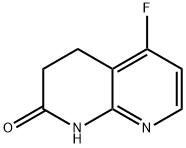
Step 3: Preparation of 5-fluoro-3,4-dihydro-1,8-naphthyridin-2(1H)-one
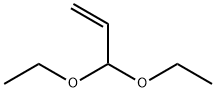
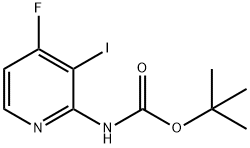
A round bottom flask was charged with tert-butyl (4-fluoro-3-iodopyridin-2-yl)carbamate (20.0 g, 59.2 mmol), 3,3-diethoxy-1-propene (13.5 mL, 88.7 mmol), DMF (150 mL), water (50 mL), DIPEA (15.4 mL, 88.7 mmol) and Pd catalyst 1 ( Corma, A.; Garcia, H.; Leyva, A. Tetrahedron 61, 9848, 2005) (480 mg, 0.827 mmol). The reaction mixture was stirred in an oil bath at 140 °C for 5 hours. After completion of the reaction, the mixture was cooled in a refrigerator for 2 days. The precipitate was separated by filtration, washed with ether and dried to give 3.25 g of pink colored needle-like crystals. The filtrate was concentrated to give a slightly reddish semi-solid. The substance was redissolved in DCM and the solution was allowed to pass through a 200 g silica gel column. The resulting solution was concentrated to give a red/orange residue, which was recrystallized from 2-propanol (150 mL) to give 9.4 g of pink solid. The pink solid was further purified by column chromatography (silica gel, eluting with a 0-75% EtOAc/DCM gradient) to give 1.41 g of white powder. The total product was 4.66 g in 47% yield.
LC/MS: (FA) ES+ 167. 1H NMR (300 MHz, d6-DMSO): δ 10.67 (s, 1H), 8.13-8.08 (m, 1H), 6.93-6.88 (m, 1H), 2.87 (t, 2H), 2.51 (t, 2H).
Note: This reaction can also be performed under the same conditions using Pd(OAc)2 as a catalyst with the ligand tri-o-tolylphosphine or no ligand. A similar method can be used for the preparation of 5-chloro-3,4-dihydro-1,8-naphthyridin-2(1H)-one from 2,4-dichloropyridine.
LC/MS: (AA) ES+ 183. 1H NMR (400 MHz, d6-DMSO): δ 10.68 (s, 1H), 8.07-8.06 (m, 1H), 7.13-7.11 (m, 1H), 2.96 (t, 2H), 2.55 (t, 2H).