General Description
Clear colorless liquid with a slight amine odor.
Reactivity Profile
N-METHYLFORMAMIDE(123-39-7) is incompatible with benzene sulfonyl chloride. N-METHYLFORMAMIDE(123-39-7) is also incompatible with strong oxidizing agents, acids, bases and acid chlorides. N-METHYLFORMAMIDE(123-39-7) may react with chlorine, bromine, nitrates, nitric acid, triethylaluminum, potassium permanganate, chromic acid, chromic anhydride, chromium trioxide, borohydrides, hydrides, thionyl chloride, metallic sodium, phosphorus trioxide, diborane, (octafluoroisobutyrate + sodium nitrite) and (perchloryl fluoride + potassium methyl 4,4-dinitrobutyrate).
Air & Water Reactions
Water soluble.
Fire Hazard
This chemical is combustible.
Acquired resistance
N-methylformamide is a clear colorless liquid with a slight amine odor. It is a water-soluble organic solvent. As an adjuvant antineoplastic agent, N-methylformamide depletes cellular glutathione, a key molecule involved in the antioxidation of reactive oxygen species (ROS) and other free radicals, thereby enhancing ionizing radiation-induced DNA cross-linking in and terminal differentiation of tumor cells. (NCI04)
Chemical Properties
CLEAR COLOURLESS LIQUID
Uses
N-Methylformamide is used in amidation or transamidation chemical reactions where formamide is insufficient.
Definition
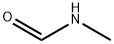
ChEBI: A member of the class of formamides having a N-methyl substituent.
Production Methods
N-Methylformamide (NMF) can be synthesized by: (1) reacting methylamine, carbon monoxide, methanol and a small amount of potassium acetate at 250 atm and 160°C; (2) heating methylamine with carbon monoxide and some sodium ethoxide in ethanol at 150 atm; (3) treating methylformate with methylamine and methanol; (4) reacting hexamethylenetetramine with formamide and hydrogen in the presence of Raney nickel at 130-145°C (Beilstein's Handbuch, 1977).
Health Hazard
As NMF is an investigational anticancer drug, a number of clinical trials have been conducted with this chemical. The first clinical evaluation was initiated in 1956 (Laird Myers et al 1956). Five patients were treated with NMF; all but one patient received the drug orally. The dose ranged from 0.1 g to 4 g per day for 2-36 days. All patients showed symptoms of toxicity - chiefly anorexia, nausea, and vomiting. Hepatic damage as measured by liver function tests was seen in all patients at total doses between 80-870 mg/kg. The liver damage appeared to be reversible with cessation of treatment. Autopsy examination of the liver of one patient showed irregular lobular disorganization, some large hepatocytes and areas of liver regeneration. McVie et al (1984) administered NMF i.v. and orally to 19 patients at a starting dose of 300 mg/m2/day for 5 days. Treatment cycles were repeated every 2 weeks and doses were escalated to 1200 mg/m2/day for 5 days. Ettinger et al (1985) treated 35 patients with NMF i.v. at doses ranging from 125-3125 mg/m2 weekly every 6 weeks. The principal toxic effects of NMF were general malaise, nausea, vomiting and anorexia. Biochemical disturbances included reversible elevation of serum levels of transaminases in several patients. The occurrence of raised serum enzyme levels did not seem to be related to the dose. Other toxic symptoms were peripheral neuropathy and alcohol intolerance in a few patients
Eisenhauer et al (1986) conducted a phase 2 clinical trial which was terminated early because of NMF-induced hepatic and gastrointestinal toxicity.
Industrial uses
NMF possesses excellent solvent properties that are similar to those of dimethylformamide. However, NMF appears to be much less important as an industrial solvent than dimethylformamide.
Metabolism
In mice, NMF is metabolized mainly to carbon dioxide, which is exhaled with the breath, and to methylamine, which is excreted with the urine (Kestell et al 1985). Of the radioactivity injected with [14C]formyl-NMF (400 mg/kg), 39% was exhaled as carbon dioxide. The amount of the drug excreted unchanged in the urine in mice was only 26% (Brindley et al 1982) and 15% of the dose was metabolized to methylamine (Kestell et al 1985). A mercapturate, N-acetyl-S-(Nmethylcarbamoyl)cysteine was identified as a major metabolite of NMF in the urine of mice, rats and patients (Kestell et al 1986). Formation of this novel metabolite involves oxidation of the formyl moiety and subsequent conjugation with glutathione (Threadgill et al 1987). On GLC analysis of the urine of mice which had received NMF, small amounts of formamide were also detected (Brindley et al 1982). Some evidence suggests that this metabolite was actually N-Hydroxy-methylformamide, the immediate product of N-methyl C-hydroxyla-tion of NMF, and not formamide (Kestell et al 1985). A^Hydroxymethylformamide, like N-hydroxymethyl-N-methylformamide, the principal metabolite of dimethylformamide, is thermally labile and breaks down to give formamide and formaldehyde; but it is stable in aqueous solution. In alkaline solution N-hydroxymethylformamide undergoes facile hydrolysis (Cooksey et al 1983). Only 14% of the radioactivity injected with [14C]methyl-NMF was exhaled as labeled carbon dioxide (Kestell et al 1985). Formate was not a urinary metabolite of NMF in mice (Kestell et al 1985).
When [14C]methyl-NMF (400 mg/kg) was injected i.p. in mice and drug plasma concentrations were determined during the first 24 h, the plasma concentration of radioactivity versus time curve was superimposable on the curve obtained by measuring unmetabolized NMF by GLC (Brindley et al 1982). Therefore, the metabolites of NMF appear to be rapidly eliminated from the blood into the urine. Radioactivity in the plasma was measurable for 8 days post NMF administration, but NMF was not detectable by GLC beyond 24 h after injection (Brindley et al 1982). The areas under the plasma concentration versus time curves after i.p., i.v. and oral administration of NMF in mice were found to be very similar (Brindley et al 1982). Similarly, the bioavailability of NMF was high in patients in a phase I clinical trial (Brindley et al 1983).
Contrary to an earlier report which claimed that NMF was biotransformed to formaldehyde by a rat liver homogenate (Barnes and Ranta, 1972), recent findings have shown that NMF does not undergo appreciable metabolism in vitro. Neither formaldehyde (or a formaldehyde precursor) could be detected as a metabolite of NMF in liver preparations or hepatocytes, nor was metabolism measurable as observed by the disappearance of substrate (Gescher et al 1982). However, NMF labeled with [14C] either in the methyl or the formyl moiety was metabolized by mouse liver microsomes in the presence of NADPH to a species which was bound covalently to microsomal protein. This covalent binding in vitro was abolished in the presence of glutathione (Pearson et al 1987a). Drug-derived radioactivity was incorporated into or bound to hepatic proteins also when [14C]NMF was administered to mice (Pearson et al 1987a). Intraperitoneal injection of NMF (200 mg/kg) in mice caused depletion of the liver glutathione pools by 79% 2 h after administration (Pearson et al 1987b). Incubation of isolated mouse hepatocytes with 7 mM NMF, which was the peak plasma concentration achieved after administration of 400 mg/kg in mice (Brindley et al 1982), led to a significant decrease in intracellular glutathione levels without an increase in glutathione disulfide (Whitby et al 1984b). Similarly, concentrations of NMF in the 0.1 M range caused glutathione depletion in cultures of human colon carcinoma cells (Cordeiro and Savarese, 1984, Cordeiro and Savarese, 1986). This depletion was accompanied by inhibition of cell growth.
Purification Methods
Dry it over molecular sieves for 2days, then distil it under reduced pressure through a column packed with glass helices. Fractionally crystallise it by partial freezing and the solid portion is distilled in a vacuum. [Beilstein 4 IV 170.]
Structure and conformation
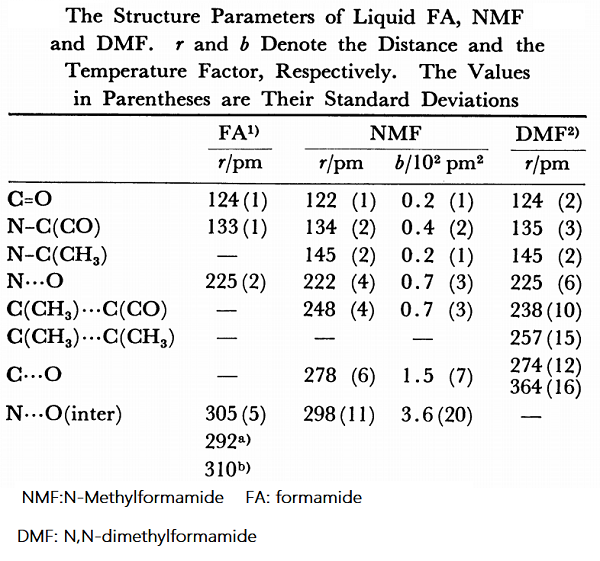
The liquid structure of N-methylformamide (NMF) has been investigated using the X-ray diffraction method and the ab initio MO-SCF method. The structure parameters within a molecule were obtained as follows: C=O: 122(1) pm, C(methyl)–N: 145(2) pm, C(carbonyl)–N: 134(2) pm, N···O: 222(4) pm, C(methyl)···O: 278(6) pm. The intermolecular hydrogen-bonded N···O distance was estimated to be 298(11) pm. A linear and flexible chain structure was proposed for the liquid structure of NMF based on scattered intensity data by the X-ray diffraction method and of interaction energies and geometries of hydrogen-bonded NMF molecules calculated by the ab initio MO calculations[1].
Toxicity evaluation
N-Methylformamide (NMF) is a metabolite of dimethylformamide (DMF), a solvent with wide applications in the chemical industry.Pregnant rats and rabbits were dosed once daily by gavage on Gestation Days 6-15 and 6-18, respectively. Doses for rats were 0, 1, 5, 10, or 75 mg/kg; doses for rabbits were 0, 5, 10, or 50 mg/kg. No treatment-related maternal deaths or clinical signs occurred in either species. Body weight gain and food consumption were depressed in rats given 75 mg/kg and rabbits given 50 mg/kg. Fetal viability was reduced at both rabbits and rats. The lowest-observed-adverse-effect levels for maternal and developmental toxicity in the rat and rabbit were 75 and 50 mg/kg, respectively. he no-observed-adverse-effect level for maternal and developmental toxicity in the rat and rabbit was 10 mg/kg[1].
References
[1] Kelich S, et al. Developmental toxicity of N-methylformamide administered by gavage to CD rats and New Zealand white rabbits. Fundam Appl Toxicol, 1995.