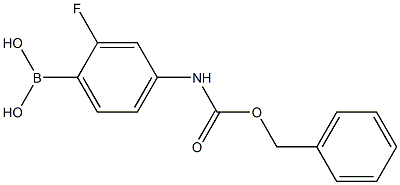
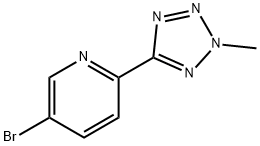
To a 5L three-necked round-bottomed flask was added (4-(((benzyloxy)carbonyl)amino)-2-fluorophenyl)boronic acid (200.0 g, 0.833 mol) followed by 1,4-dioxane (3L, 15 vol). The crude compound 2-(2-methyl-tetrazolyl)-5-bromopyridine (361.2 g, 1.249 mol, 1.5 eq.), tris(dibenzylideneacetone)dipalladium (11.44 g, 0.0125 mol, 0.015 eq.) and tricyclohexylphosphine (7.0 g, 0.025 mol, 0.03 eq.) were added and protected with nitrogen for 30 min. A solution of potassium carbonate (195.7 g, 1.7 eq.) in water (800 mL, 4 v/v) was added and the reaction was heated to 70 °C. After 1 h the reaction was complete with 0.5 area % of (4-(((benzyloxy)carbonyl)amino)-2-fluorophenyl)boronic acid remaining. The reaction was cooled to 50 °C, activated carbon Darco G-60 (40 g, 0.2 wt) was added and stirred for 30 min. Diatomaceous earth 545 (40 g, 0.2 wt) was added and the reaction was filtered through diatomaceous earth 545 (100 g, 0.5 wt) wetted with water (300 mL). Hot filtration from the diatomaceous earth into water resulted in precipitation of the product. Tetrahydrofuran (1.2 L, 6 vol) and brine (600 mL, 3 vol) were added and the product redissolved at room temperature. Phase separation was completely clean (Vmax = 28 vol). The dioxane was concentrated, ethanol (1L, 5 vol) was added and concentrated. The product was then re-slurried in ethanol: water (4:1,2L, 10 vol) at 70°C, cooled to room temperature over 3 h, filtered and washed with ethanol (2 x 400 mL). Benzyl (3-fluoro-4-(6-(2-methyl-2H-tetrazol-5-yl)pyridin-3-yl)phenyl)carbamate was isolated in 87% yield (292.6 g) by HPLC analysis with a purity of 97.7% (AUC).1H NMR and 19F NMR indicated the presence of a compound.Pd analysis showed that the product contained 135 ppm Pd.

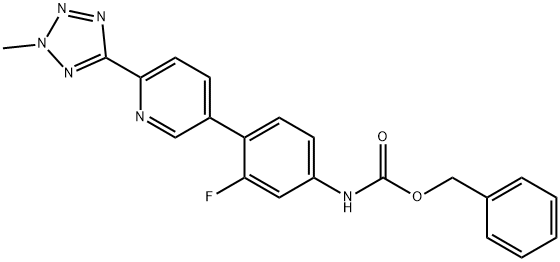

![CarbaMic acid, N-[3-fluoro-4-[6-(2-Methyl-2H-tetrazol-5-yl)-3-pyridinyl]phenyl]-, phenylMethyl ester](/CAS/GIF/1220910-89-3.gif)