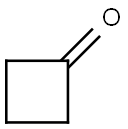
In a 2-L, three-necked, round-bottomed flask equipped with a reflux condenser are placed 250 mL of water, 48 mL (ca. 0.55 mol) of concentrated hydrochloric acid, and 49.5 g (0.65 mol) of cyclopropylcarbinol; the reaction mixture is refluxed for ca. 100 min. The flask is then immersed in an ice bath equipped with a mechanical stirrer, a thermometer, and a dropping funnel (using a three-way adapter, parallel sidearm), and the reflux condenser is replaced by an ethanol–dry ice trap connected to a U-tube immersed in an ethanol–dry ice bath to ensure condensation of the very volatile cyclobutanone. The flask is charged with an additional 48 mL (ca. 0.55 mol) of concentrated hydrochloric acid in 200 mL of water and 440 g (3.5 mol) of oxalic acid dihydrate. The heterogeneous mixture is stirred for ca. 15 min to saturate the solution with oxalic acid. A solution of 162 g (1.62 mol) of chromium trioxide in 250 mL of water is added dropwise with stirring at such a rate that the temperature of the reaction mixture is kept between 10°C and 15°C (NaCl–ice bath, −5°C to −10°C) and the generation of carbon dioxide remains gentle. After the oxidation is completed, the ice bath is removed and stirring is continued for ca. 1 hr to bring the reaction mixture to room temperature.
The reaction mixture is poured into a 2-L separatory funnel and extracted with four 200-mL portions of methylene chloride. The extracts (the lower phase) are combined, dried over anhydrous magnesium sulfate containing a small amount of anhydrous potassium carbonate (to remove traces of hydrochloric acid), and filtered, and the filtrate is concentrated by distillation through a vacuum-insulated silvered column packed with glass helices and equipped with an adjustable stillhead, until the pot temperature rises to 80°C. The crude product is then transferred to a 100-mL flask and distilled through the same column (reflux ratio 10:1) to give 14–16 g (0.20–0.23 mol), 31–35% overall yield (based on pure cyclopropyl carbinol) of cyclobutanone.