Description
1,7-BIS-BOC-1,4,7-TRIAZAHEPTANE contains two Boc protecting groups which can be removed under acidic conditions. The remaining free amines can further react with carbonyl moieties.
Chemical Properties
1,7-BIS-BOC-1,4,7-TRIAZAHEPTANE is white powder
Uses
1,7-BIS-BOC-1,4,7-TRIAZAHEPTANE is used in the preparation of bifunctional chelators that have been then applied to the synthesis of monoclonal antibody conjugates for tumor targeting.
Synthesis
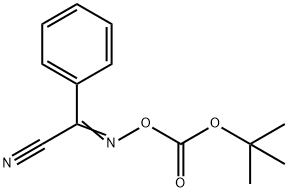
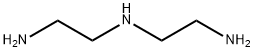
Synthesis of DiBoc-DETA: (0245) Diethylenetriamine (1.03 g, 10 mmol) was dissolved in 10 mL of anhydrous tetrahydrofuran and bubbled under nitrogen atmosphere for 20 min to deoxidize. A 3-fold molar amount of 2-(tert-butoxycarbonyloxyimino)-2-phenylacetonitrile (Boc-ON) dissolved in 15 mL of anhydrous tetrahydrofuran was added slowly and dropwise to the diethylenetriamine solution at 0 °C in an ice bath. The reaction mixture was continued to be stirred at 0 °C for 2 hours. After completion of the reaction, the solvent was removed by rotary evaporator under reduced pressure. The crude product 1,7-bis-BOC-1,4,7-triazepane (DiBoc-DETA) was purified by column chromatography with the eluent being a solvent mixture of ethyl acetate and hexane (1:15, v/v) in a final yield of 90%.
in vitro
1,7-Bis-Boc-1,4,7-triazaheptane is an alkyl/ether-based PROTAC linker that can be used in the synthesis of PROTACs. PROTACs contain two different ligands connected by a linker; one is a ligand for an E3 ubiquitin ligase and the other is for the target protein. PROTACs exploit the intracellular ubiquitin-proteasome system to selectively degrade target proteins
References
[1] Macromolecules, 2012, vol. 45, # 17, p. 7157 - 7162
[2] Patent: US2007/82867, 2007, A1
[3] Inorganic Chemistry, 2014, vol. 53, # 2, p. 1144 - 1155
[4] Patent: US2016/279084, 2016, A1. Location in patent: Paragraph 0244; 0245
[5] Organic and Biomolecular Chemistry, 2014, vol. 12, # 43, p. 8598 - 8602