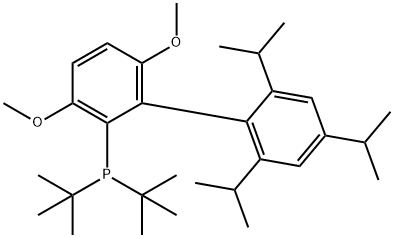
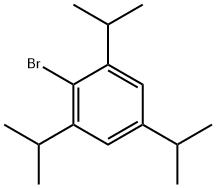
Example 3: Synthesis of Ligand 6; A reflux condenser, glass stopper and rubber septum were assembled to an oven-dried, three-necked, 100 mL round-bottomed flask equipped with a magnetic stir bar. After addition of magnesium chips (360 mg, 15.36 mmol), the flask was evacuated and backfilled with argon (this process was repeated three times). THF (40 mL) and 2,4,6-triisopropylbromobenzene (3.62 g, 12.8 mmol) were added via syringe, heated to reflux and 1,2-dibromomethane (40 μL) was added dropwise. The reaction mixture was stirred at reflux for 1 h and cooled to room temperature.
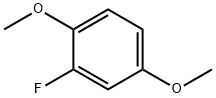
In another oven-dried 500 mL Schlenk flask, a magnetic stir bar and septum were added, evacuated and backfilled with argon (repeated 3 times). THF (160mL) and 1,4-dimethoxy-2-fluorobenzene (2g, 12.8mmol) were added via syringe and cooled to -78°C. n-BuLi (2.5 M hexane solution, 5.12 mL, 12.8 mmol) was added dropwise over 15 min with stirring for 30 min. The previously prepared Grignard reagent was added by cannula transfer and stirred at -78 °C for 1 hour. Slowly warmed to room temperature and continued stirring for 3 hours.
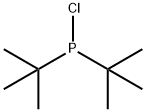
Anhydrous CuCl (1.267 g, 12.8 mmol) was added rapidly under argon protection, followed by ClP(t-Bu)2 (2.44 mL, 12.8 mmol) via syringe, and the Schlenk tube was sealed with a PTFE screw cap. The reaction mixture was heated to 75 °C, kept for 48 h and then cooled to room temperature. The reaction was quenched with 30% NH4OH aqueous solution (100 mL) and extracted with EtOAc (200 mL). The organic layer was washed sequentially with 30% aqueous NH4OH (3 x 100 mL) and brine (100 mL), dried over MgSO4, filtered and concentrated to give a yellow oil. The crude product was dissolved in a minimal amount of hot MeOH and crystallized overnight at -25 °C in a refrigerator to give 1.11 g of white crystals (18% yield).


 ;
;