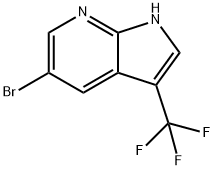
General procedure for the synthesis of 3-(trifluoromethyl)-1H-pyrrolo[2,3-b]pyridine from 3-(trifluoromethyl)-1H-pyrrolo[2,3-b]pyridine: Bromine (36.2 g, 0.2 mol) was added slowly and dropwise over a period of 1 h to dry dichloromethane (200 mL) that was cooled to -5°C. The reaction was followed by the addition of bromine (36.2 g, 0.2 mol). Subsequently, a solution of 3-(trifluoromethyl)-1H-pyrrolo[2,3-b]pyridine (25 g, 0.13 mol) and pyridine (17 mL) in dichloromethane (500 mL) was added dropwise. After dropwise addition, the reaction mixture was stirred at -5°C for 45 minutes. After completion of the reaction, the mixture was poured into a mixture of saturated aqueous sodium bicarbonate and sodium thiosulfate and extracted with ethyl acetate (3 x 1000 mL). The organic layers were combined, washed with brine, dried over anhydrous sodium sulfate and subsequently concentrated to dryness under vacuum. The resulting residue was purified by recrystallization (ethyl acetate: petroleum ether = 8:1) to afford the target product 5-bromo-3-(trifluoromethyl)-1H-pyrrolo[2,3-b]pyridine (7.55 g, 21% yield). The structure of the product was confirmed by NMR hydrogen spectroscopy (400 MHz, DMSO-d6): δ 12.76 (s, 1H), 8.44 (s, 1H), 8.23 (m, 2H).

![3-Trifluoromethyl-1H-pyrrolo[2,3-b]pyridine](/CAS2/GIF/892414-47-0.gif)
![5-broMo-3-(trifluoroMethyl)-1H-pyrrolo[2,3-b]pyridine](/CAS/20150408/GIF/1150618-36-2.gif)