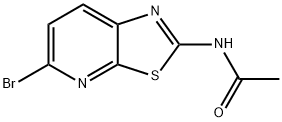
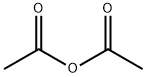
Example 1: Potassium thiocyanate (42.1 g, 433 mmol) was added to a 500 mL three-necked flask under nitrogen protection, followed by 225 mL of acetic acid. The mixture was cooled to -5 °C and 6-bromo-3-aminopyridine (15 g, 86.7 mmol) was added in batches. Further cooled to -15°C, a solution of bromine (5.7 mL) in 12 mL of acetic acid was added dropwise while controlling the bath temperature below 10°C. Slowly warm to room temperature and stir overnight. A small amount of precipitate was removed by filtration. The mother liquor was cooled to 0 °C, water (200 mL) was added, and after stirring for 5 min, the precipitate was collected and washed with cold methanol/ether (1:3, 50 mL, 2 times). The solid was dried overnight under vacuum to give 5-bromothiazolo[5,4-b]pyridin-2-amine (10.2 g, 51%). The filtrate was concentrated to half the original volume, the precipitate was collected, washed with cold methanol-ether and dried to give 2 g of additional product in a total yield of 12.2 g (61% yield). To a solution of pyridine (88 mL) of the above product (11.3 g, 40 mmol) was slowly added ethanoic anhydride (44 mL) at 0 °C and stirred for 16 h at room temperature. The solvent was removed and the residue was dried under vacuum for 20 h to give N-(5-bromothiazolo[5,4-b]pyridin-2-yl)acetamide (13.3 g, 100%) as a light brown solid. Mass spectrometry analysis: [M + H] C8H6BrN3OS calculated value 272, measured value 272.


![2-AMINO-5-BROMOTHIAZOLO[5,4-B]PYRIDINE](/CAS/GIF/934266-82-7.gif)
![N-(5-BroMothiazolo[5,4-b]pyridin-2-yl)acetaMide](/CAS/GIF/1112982-76-9.gif)