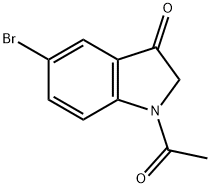
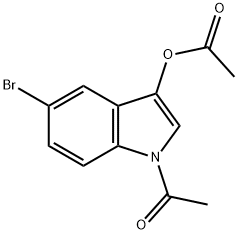
The general procedure for the synthesis of 1-acetyl-5-bromoindol-3-one from 5-bromohydroxyindolyl diacetate was as follows: 0.82 g (2.75 mmol) of 1-acetyl-5-bromoindolyl acetate was added to the reaction system in batches, maintaining the reaction temperature at 5 °C with continuous stirring, with reference to the method for the preparation of 1-acetyl-5-bromo-6-chloro-indol-3-ol. Subsequently, sulfuric acid (exact volume not specified) was slowly added. The reaction mixture was stirred at room temperature for 1 hour before being cooled in an ice-water bath and filtered, and the filter cake was washed with an ice-water solution of 1% sodium glacial acetic acid. The resulting greenish-blue product was lyophilized to give 0.67 g of solid product in 80% yield. Thin layer chromatography (TLC) analysis showed an Rf value of 0.2 (unfolding agent was cyclohexane:ethyl acetate=3:2). High resolution mass spectrometry (HRMS-ESI) analysis showed that the m/z calculated value of C10H10BrNO2 was 252.9738 and the measured value was 252.9727. Nuclear magnetic resonance hydrogen spectroscopy (1H NMR, 400MHz, CD3OD) data: δ 8.47 (d, 1H, J=8.8 Hz, H-7), 7.85 (d, 1H, J=2.0 Hz, H-4), 7.74 (dd, 1H, H-6), 5.29 (s, 1H, CH2), 2.38 (s, 3H, CH3). Nuclear magnetic resonance carbon spectroscopy (13C NMR, 100 MHz, CD3OD) data: δ 192.7 (C-3), 167.6 (C=O), 151.9 (C-8), 139.3 (C-6), 138.9, 125.8 (C-4), 119.7 (C-7), 116.8, 114.0, 55.7 (CH2), 23.6 ( CH3).