Chemical Properties
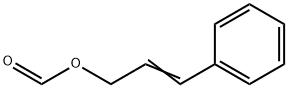
Cinnamyl formate has a balsamic, fruital-floral odor and bittersweet taste reminiscent of apple.
Occurrence
Reported found in narcissus.
Uses
Cinnamyl formate is used in trace amounts in flavor compositions, particularly Apple, Banana, Cherry,Pear, Spice, etc. It is particularly interesting in imitation Banana, where it can produce true-to-Nature notes if used discretely, and perhaps in combination with Mimosa absolute, also in traces.
Preparation
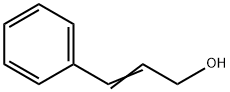
By esterification of cinnamyl alcohol with formic acid.
Aroma threshold values
Detection at 1.0%: cinnamon spicy, slightly balsamic, cherry fruity with berry and tropical nuances.
Taste threshold values
Taste characteristics at 5 ppm: sweet, cinnamon-like, astringent, with woody resinous and balsamic nuances.
General Description
Cinnamyl formate is an α,β-unsaturated?ester that can be used as a flavoring agent and a fragrance ingredient.
Flammability and Explosibility
Notclassified
Synthesis
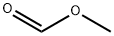
To a flame-dried flask equipped with a stir bar and activated molecular sieves, IMes-HCl (A1-HCl, 6.8 mg, 0.02 mmol) and toluene (2 mL) were added under an inert atmosphere. A toluene solution of 0.5 M KHMDS (0.04 mL) was slowly added to the stirring suspension with continuous stirring for 15 min. Subsequently, a toluene (2 mL) solution of cinnamyl alcohol (1 mmol) and methyl formate (600 mg, 10 mmol) was added, the flask was sealed, and the reaction was heated for 16 hours at 45 °C. Upon completion of the reaction, the crude product was directly sampled onto a silica gel column for purification, resulting in cinnamyl formate.
Metabolism
Cinnamyl formate is hydrolysed by porcine pancreatic lipase 2.6 times more rapidly than is cinnamyl oleate under identical conditions (Brockerhoff, 1970).
References
[1] Synthesis (Germany), 2017, vol. 49, # 15, p. 3505 - 3510