
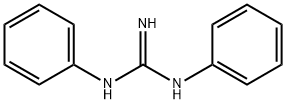
102-06-7
| Name | 1,3-Diphenylguanidine |
| CAS | 102-06-7 |
| EINECS(EC#) | 203-002-1 |
| Molecular Formula | C13H13N3 |
| MDL Number | MFCD00001758 |
| Molecular Weight | 211.26 |
| MOL File | 102-06-7.mol |
Chemical Properties
| Appearance | white or cream powder with a slight odour |
| Melting point | 146-148 °C(lit.) |
| Boiling point | 170°C |
| density | 1,13 g/cm3 |
| vapor pressure | 0Pa at 25℃ |
| refractive index | 1.6000 (estimate) |
| Fp | 170°C |
| storage temp. | Store below +30°C. |
| solubility | Soluble in alcohol, chloroform, hot benzene, hot toluene, and dilute mineral acids |
| form | Powder |
| pka | pK1:10.12 (25°C) |
| color | Pale Cream |
| Odor | wh. powd., bitter taste, sl. odor |
| PH | 10.2 (10g/l, H2O) |
| Stability: | Stable. Combustible. Incompatible with strong oxidizing agents. Moisture sensitive. |
| Water Solubility | slightly soluble |
| Merck | 14,3324 |
| BRN | 1875653 |
| Henry's Law Constant | 1.4×10⁶ mol/(m3Pa) at 25℃, HSDB (2015) |
Safety Data
| Symbol(GHS) |    GHS06,GHS08,GHS09 |
| Signal word | Danger |
| Hazard statements | H301-H315-H319-H335-H361f-H411 |
| Precautionary statements | P202-P261-P273-P301+P310-P302+P352-P305+P351+P338 |
| Hazard Codes | Xn,N |
| Risk Statements | |
| Safety Statements | |
| RIDADR | UN 3077 9/PG 3 |
| WGK Germany | 2 |
| RTECS | MF0875000 |
| TSCA | Yes |
| REACH Registrations | Active |
| HazardClass | 9 |
| PackingGroup | III |
| HS Code | 29252000 |
| Storage Class | 6.1C - Combustible acute toxic Cat.3 toxic compounds or compounds which causing chronic effects |
| Hazard Classifications | Acute Tox. 3 Oral Aquatic Chronic 2 Eye Irrit. 2 Repr. 2 Skin Irrit. 2 STOT SE 3 |
| Safety Profile | |
| Hazardous Substances Data | 102-06-7(Hazardous Substances Data) |
| Toxicity |