To the reaction vessel was added 5-bromo-2-chloro-N-cyclopentyl-4-pyrimidinamine (10.0 g, 1.0 eq.) and N-methylpyrrolidone (NMP, 50 mL, 5.0 vol.) at room temperature. Subsequently, crotonic acid (4.7 g, 1.5 eq.) and triethylamine (20.2 mL, 4.0 eq.) were added to the reaction mixture. The vessel was degassed and purged three times with nitrogen. Palladium acetate (Pd(OAc)2, 0.25 g, 0.03 eq.) was added to the degassed reaction mixture. The vessel was again degassed and purged with nitrogen three times in the same manner. The reaction mixture was heated to 65 °C and stirred continuously until the feedstock was completely consumed (at least 6 hours). Then, acetic anhydride (6.8 mL, 2.0 eq.) was added to the reaction mixture. The reaction was kept at 65 °C until the feedstock was completely consumed (usually takes 1-2 hours). Upon completion of the reaction, the mixture was cooled to 20 °C and water (100 mL, 10 v/v) was added to dissolve the triethylamine-HBr salt while 2-chloro-8-cyclopentyl-5-methyl-8H-pyrido[2,3-d]pyrimidin-7(8H)-one was precipitated. The precipitate was stirred at 20°C for 1 hour. The solid was collected by filtration and washed sequentially with a mixture of water (20 mL, 2.0 v/v) and isopropanol/water (4:1, 50 mL, 5.0 v/v). Finally, the crude product was vacuum dried at 55-70 °C to afford 2-chloro-8-cyclopentyl-5-methyl-8H-pyrido[2,3-d]pyrimidin-7(8H)-one (7.8 g, 81% yield) as a tan to gray solid.

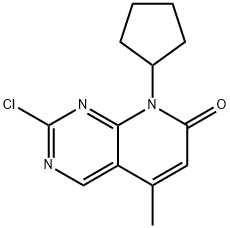

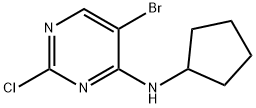
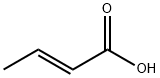
![2-chloro-8-cyclopentyl-5-Methylpyrido[2,3-d]pyriMidin-7(8H)-one](/CAS/20150408/GIF/1013916-37-4.gif)