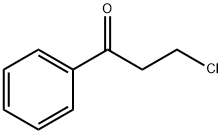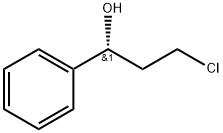
100306-33-0
| Name | (1R)-3-Chloro-1-phenyl-propan-1-ol |
| CAS | 100306-33-0 |
| EINECS(EC#) | 627-168-3 |
| Molecular Formula | C9H11ClO |
| MDL Number | MFCD00075128 |
| Molecular Weight | 170.64 |
| MOL File | 100306-33-0.mol |
Chemical Properties
| Appearance | Off-white Cryst |
| Melting point | 58-60 °C (lit.) |
| alpha | 26 º (c=1, chloroform) |
| Boiling point | 296.4±20.0 °C(Predicted) |
| density | 1.149±0.06 g/cm3(Predicted) |
| storage temp. | Inert atmosphere,Room Temperature |
| solubility | Chloroform (Slightly), Methanol (Slightly) |
| form | Powder |
| pka | 13.92±0.20(Predicted) |
| color | White to yellow |
| Optical Rotation | [α]24/D +26°, c = 1 in chloroform |
| BRN | 5250766 |
| InChI | InChI=1/C9H11ClO/c10-7-6-9(11)8-4-2-1-3-5-8/h1-5,9,11H,6-7H2/t9-/s3 |
| InChIKey | JZFUHAGLMZWKTF-SECBINFHSA-N |
| SMILES | [C@@H](C1C=CC=CC=1)(O)CCCl |&1:0,r| |
| CAS DataBase Reference | 100306-33-0(CAS DataBase Reference) |
Safety Data
| Symbol(GHS) |  GHS07 |
| Signal word | Warning |
| Hazard statements | H315-H319-H335 |
| Precautionary statements | P264-P280-P302+P352+P332+P313+P362+P364-P305+P351+P338+P337+P313-P261-P305+P351+P338 |
| Hazard Codes | Xi |
| Risk Statements | |
| Safety Statements | |
| WGK Germany | 3 |
| HazardClass | IRRITANT |
| HS Code | 29062990 |
| Storage Class | 11 - Combustible Solids |
| Hazard Classifications | Eye Irrit. 2 Skin Irrit. 2 STOT SE 3 |